
What Makes an Audiology Website Trustworthy to New Patients?
Introduction
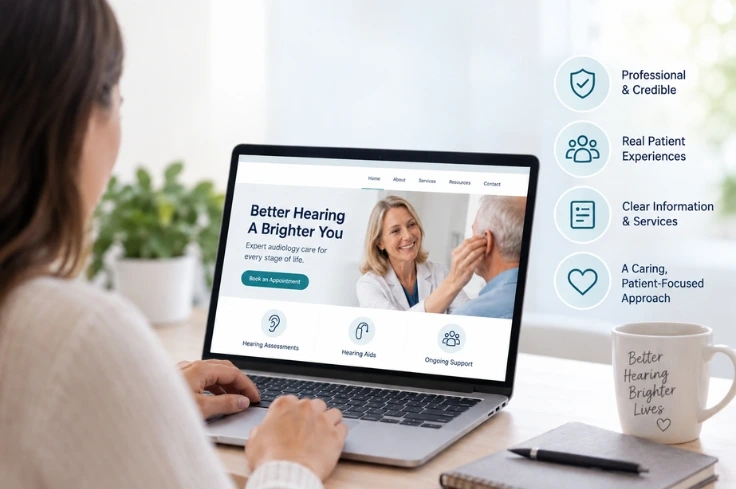
A trustworthy audiology website helps patients feel confident in choosing your practice. From clear information and patient reviews to easy navigation and simple appointment options, every element should build credibility and make it easy for visitors to take the next step.
Choosing an audiologist can feel like a personal decision. Patients are not simply comparing products or prices. They may be looking for help with hearing changes, tinnitus, communication difficulties, or concerns about a family member.
Before calling a clinic, many people visit its website to learn more about the practice. They may want to know who will provide their care, what services are available, what the appointment may involve, and whether the clinic feels like a place they can trust.
This means an audiology website has an important job. It should help new patients feel informed and comfortable enough to take the next step.
Trust does not come from one website feature. It develops through clear information, professional presentation, helpful content, and a consistent patient experience.
Here are some of the elements that can make an audiology website feel more trustworthy to prospective patients.
1. Clear Information About the Audiologists
For many patients, one of the first questions is simple: Who will I be seeing?
A website should make it easy to learn about the audiologists and other hearing care professionals at the practice. Provider pages can include information such as:
- Professional qualifications
- Education and training
- Areas of experience
- Professional memberships
- Special interests
- A professional photograph
- A short personal introduction
This information helps put a person behind the practice name.
Patients may feel more comfortable scheduling when they can see who will be caring for them and understand that they are working with a qualified hearing care professional.
Provider information should also be kept current. If a provider leaves the practice or a new audiologist joins the team, the website should be updated accordingly.
2. Easy-to-Understand Service Information
Patients do not always know the clinical terminology associated with hearing care.
Someone might know that conversations have become harder to follow, but they may not know which type of hearing evaluation they need. Another person may be experiencing ringing in the ears without knowing what type of professional they should contact.
Service pages should help answer these questions in straightforward language.
Rather than filling a page with complicated terminology, explain:
- What the service is
- Who may benefit from it
- What a patient can expect
- What usually happens during an appointment
- What the next steps may be
Clear information can reduce uncertainty before a patient contacts the clinic.
It can also help patients understand that the practice offers professional care rather than simply selling hearing devices.
3. Real Patient Reviews and Testimonials
Reviews are often an important part of the decision-making process.
A prospective patient may read Google reviews before visiting the website, or they may look for testimonials after arriving on the site.
Reviews can provide social proof that other people have had positive experiences with the practice.
Patients often pay attention to comments about:
- How staff treated them
- Whether the audiologist listened to their concerns
- How clearly results were explained
- Appointment scheduling
- Follow-up care
- Overall experience
Practices should focus on genuine feedback rather than trying to make every review sound perfect.
A combination of recent reviews and thoughtful responses can show prospective patients that the practice values patient experiences.
When using testimonials directly on a website, practices should also follow applicable privacy and consent requirements.
A strong online reputation management strategy can also help audiology practices monitor reviews, strengthen patient trust, and respond professionally to feedback.
4. Professional Photos of the Actual Practice
Stock photography can make a website look polished, but it does not always help patients understand what the real practice is like.
Whenever possible, include authentic photos of the clinic, team, and environment.
For example, a website could show:
- The reception area
- Consultation rooms
- Audiologists and staff
- Hearing testing equipment
- The exterior of the clinic
These images help patients become familiar with the practice before arriving.
This can be particularly helpful for someone who is nervous about their first hearing appointment.
Professional photography does not need to make a clinic look luxurious. The goal is to accurately show a welcoming, professional environment.
5. Consistent Contact and Location Information
Trust can quickly decrease when basic information is inconsistent.
Imagine a patient finds one phone number on the website, another on Google, and different office hours on a third platform. They may wonder which information is correct.
The practice name, address, phone number, hours, and other important contact details should be accurate and consistent.
For practices with multiple locations, each location should have clear information about:
- Address
- Phone number
- Office hours
- Providers
- Available services
- Directions
- Scheduling options
This does more than make the website easier to use. It also reassures visitors that the practice maintains an active and professional online presence.
For practices that want to improve their visibility in local searches and Google Maps, local SEO can help strengthen location-based visibility and make it easier for nearby patients to discover the practice.
6. A Website That Is Easy for Older Adults to Use
Many audiology practices serve a significant number of older adults. Website usability should reflect their needs without making the design feel outdated.
Small fonts, low contrast, confusing menus, crowded pages, and tiny buttons can make a website difficult to use.
A patient should not have to struggle to find a phone number or understand how to schedule an appointment.
Helpful usability features can include:
- Readable font sizes
- Strong contrast between text and backgrounds
- Clear navigation
- Descriptive headings
- Large buttons
- Short paragraphs
- Mobile-friendly pages
- Simple forms
It is also important to consider that family members may be researching care on behalf of a parent, spouse, or relative.
The website should work well for both patients and caregivers.
A well-designed website should combine visual presentation with usability, performance, content, and conversion opportunities. Audiology website design and digital marketing solutions can help practices create a more patient-friendly online experience.
7. Helpful Content That Answers Real Questions
A trustworthy website should do more than describe services.
Patients often have questions before they are ready to schedule. Educational content can help answer those questions and make the practice a useful resource during the research process.
For example, patients may want to know:
- What happens during a hearing test?
- How long does a hearing evaluation take?
- When should someone see an audiologist?
- What is the difference between hearing aid styles?
- What should they bring to their appointment?
- How often should hearing be checked?
Blog articles, FAQs, videos, and service page content can help address these concerns.
However, quality matters more than publishing a large amount of content.
Articles should be accurate, easy to understand, useful, and relevant to the patients the practice serves.
For practices looking to make their content easier for search engines and AI-powered search experiences to understand, AEO and GEO strategies can help organize and strengthen important practice, service, and educational information.
8. Clear Information About What Happens Next
Uncertainty can prevent someone from taking action.
A patient may be interested in scheduling but hesitate because they do not know what will happen after completing a form.
Websites can reduce this uncertainty by clearly explaining the next step.
For example, instead of a button that simply says “Submit,” a practice might use a clearer call to action such as “Request an Appointment.”
The page can then explain whether the practice will call the patient, how appointment requests are handled, or what information they may need to provide.
Small details like these can make the scheduling process feel more predictable.
Clear calls to action and a well-planned patient journey are also important parts of lead conversion for hearing clinics.
9. A Secure and Well-Maintained Website
Patients may also judge a practice based on how well its website works.
Broken pages, security warnings, outdated information, slow loading times, or forms that do not work can create a poor first impression.
A trustworthy website should be maintained just like other parts of the practice.
Important areas to monitor include:
- HTTPS security
- Broken links
- Contact forms
- Mobile usability
- Page speed
- Outdated provider information
- Old promotions
- Incorrect office hours
Regular website checks can help identify problems before they affect prospective patients.
Website performance also matters for search visibility and user experience. Audiology Plus explains that website speed, responsive design, and ongoing optimization can contribute to a better online experience and stronger SEO performance. Learn more about website optimization and audiology marketing FAQs.
10. A Consistent Experience Across the Web
A patient may interact with several online touchpoints before scheduling.
They might first discover the practice through Google, read reviews, visit the website, view a provider profile, and then return later to request an appointment.
These experiences should feel connected.
The clinic’s branding, contact details, services, messaging, and overall professionalism should be consistent across its website, Google Business Profile, social media accounts, directories, and other online platforms.
Consistency makes it easier for prospective patients to feel confident that they have found the correct practice and accurate information.
Trust Starts Before the First Appointment
A patient’s relationship with an audiology practice can begin long before they walk through the clinic doors.
The website may be one of their first meaningful interactions with the practice.
Clear provider information, helpful service explanations, genuine reviews, authentic photography, accessible design, accurate contact details, and an easy scheduling experience can all help create a stronger first impression.
The goal is not to make a website look perfect. It is to make it feel clear, professional, useful, and consistent with the care patients can expect from the practice.
For audiology clinics, building that trust online can make it easier for prospective patients to move from researching their options to feeling confident about contacting the practice.
At Audiology Plus, we help audiology practices create professional websites and digital experiences designed around the needs of hearing care patients. From website design and content to SEO and digital marketing, our team helps audiology practices strengthen their online presence, communicate their expertise, and make it easier for prospective patients to take the next step.
If your current website does not reflect the quality of care your practice provides, Audiology Plus can help you build a stronger and more trustworthy online presence.
Get in Touch
Have questions about improving your audiology website? Get in touch with Audiology Plus today to learn how we can help you build a trustworthy online presence and attract more patients.
Get Started with a
Free Consultation
Unlock the full potential of your marketing efforts.
