
How Can Audiology Practices Market Multiple Services Without Confusing Google?
Introduction
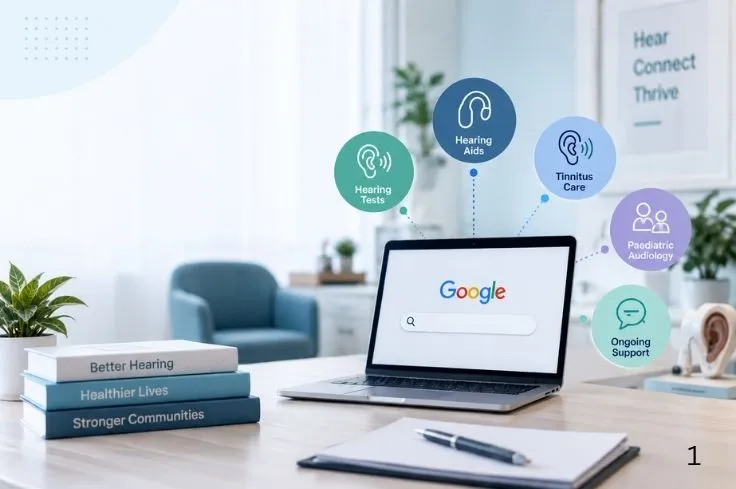
Audiology practices often offer multiple services, from hearing evaluations and hearing aids to tinnitus care, pediatric audiology, and balance testing. A clear website structure helps patients find the right information while making it easier for Google and AI search platforms to understand each service.
Most audiology practices do more than one thing.
A clinic may offer hearing evaluations, hearing aids, tinnitus care, hearing aid repairs, custom hearing protection, balance testing, pediatric audiology, cochlear implant support, and other hearing services.
From a patient perspective, offering several services is helpful. From a website perspective, however, those services need to be organized carefully.
If several pages talk about the same topics in almost the same way, it can become difficult for search engines to understand which page best answers a particular search. Patients can also struggle to find the information they need.
The solution is not to reduce the number of services you promote. It is to give every important service a clear place and purpose on your website.
Here is how audiology practices can market multiple services while creating a clearer experience for both patients and search engines.
Start with the Services Patients Actually Search For
Before creating new pages, think about how patients look for hearing care.
A person who wants a hearing test has a different need from someone looking for hearing aid repair. A patient researching tinnitus may also be at a different stage than someone ready to schedule a hearing aid consultation.
These differences matter.
Your website structure should reflect the different reasons people search for your practice.
For example, a clinic may have separate pages for:
- Hearing evaluations
- Hearing aids
- Hearing aid repair
- Tinnitus care
- Pediatric hearing care
- Balance testing
- Custom hearing protection
You do not need to create a page for every small variation of a service. Instead, focus on services that represent a meaningful and distinct patient need.
Ask a simple question before creating a page: Would someone specifically search for this service and expect dedicated information about it?
If the answer is yes, a separate page may make sense.
Give Each Service Page One Clear Purpose
One of the easiest ways to create confusion is to have several pages trying to answer the same search.
Imagine an audiology website has these pages:
- “Hearing Tests”
- “Hearing Evaluations”
- “Comprehensive Hearing Testing”
If all three contain similar information and target the same type of patient, they may be competing for the same search intent.
Instead of creating several similar pages, consider having one strong page that fully explains the service.
That page can answer important questions such as what happens during an evaluation, who may benefit from one, how patients can prepare, what happens after testing, and how to request an appointment.
This creates a clear destination for that topic.
The same principle applies to other services. Your hearing aid repair page should focus on repair needs. Your tinnitus page should focus on patients looking for help with tinnitus. Your pediatric audiology page should speak to parents and caregivers.
Clear page purposes make the website easier to understand.
Avoid Creating Pages for Every Keyword Variation
Years ago, websites sometimes created separate pages for slightly different keyword phrases.
For example:
- “hearing test in Dallas”
- “hearing evaluation in Dallas”
- “hearing testing services in Dallas”
Today, that approach can easily lead to repetitive, low-value content.
Google has become much better at understanding related words and the meaning behind a search. You generally do not need a separate page just because patients use different wording for the same service.
Instead, build a useful page around the main topic and naturally discuss related terms where they help the reader.
The goal should be to satisfy the patient’s need, not to create as many keyword-targeted URLs as possible.
Understand the Difference Between Service Pages and Blog Posts
Service pages and blog posts should have different jobs.
A service page helps a prospective patient understand a service your clinic provides and decide whether to contact your practice.
A blog post usually answers a narrower informational question.
For example, your hearing aid service page might explain your clinic’s approach to hearing aids, available options, the fitting process, follow-up care, and how to schedule an appointment.
Your blog could then answer questions such as:
- “How Often Should Hearing Aids Be Checked?”
- “Why Does My Hearing Aid Keep Whistling?”
- “What Should I Bring to a Hearing Aid Appointment?”
These articles support the main service without trying to replace it.
This structure can also help prevent keyword cannibalization because the service page owns the main commercial topic while supporting articles address specific informational questions.
Connect Related Content with Internal Links
Once your website has clear service pages and supporting content, connect them.
Internal links help patients discover useful information and help search engines understand relationships between pages.
For example, an article about signs that someone may need a hearing evaluation could naturally link to the clinic’s hearing testing page.
An article about common hearing aid problems could point readers toward hearing aid repair information.
The relationship can also work in the other direction. A service page can link to useful educational resources when patients may want more detailed answers.
Think of your website as a connected information system rather than a collection of unrelated pages.
This same approach is important when building a broader audiology marketing strategy. Search visibility, website content, patient experience, reputation, and lead conversion work better when they support one another.
Be Careful with Multiple Locations
Website structure becomes even more important when an audiology practice has several offices.
Patients often need location-specific information, so dedicated location pages can be valuable. However, creating nearly identical pages and changing only the city name does not provide much additional value.
A useful location page should help someone who is considering visiting that particular office.
It might include:
- Address and contact information
- Office hours
- Audiologists working at that location
- Services available there
- Parking or arrival information
- Areas commonly served
- Appointment information
- Photos of the office
If certain services are only available at selected locations, make that clear.
This creates a better patient experience and gives search engines more accurate information about the relationship between your services and locations.
For practices trying to improve visibility in Google Maps and location-based searches, a well-planned site structure should work alongside your local search strategy.
Make Service Relationships Easy to Understand
Search engines are not the only audience you should think about.
AI-powered search experiences are also changing how people find healthcare information and providers.
Someone might ask an AI assistant:
- “Where can I get a hearing test near me?”
- “Which type of doctor helps with tinnitus?”
- “Does this hearing clinic treat children?”
For an AI system to understand your practice, your website should clearly communicate relationships between your clinic, providers, locations, and services.
For example, your website should make it easy to understand:
- Audiologist → works at → Location
- Location → offers → Service
- Service → provided by → Practice
- Provider → specializes in → Area of care
- Clear page structure, consistent information, descriptive headings, provider information, internal links, and structured data can all contribute to a more understandable online presence.
This is becoming increasingly important as practices think beyond traditional search and consider AEO and GEO for audiologists.
Review Your Existing Content Before Adding More
More content does not automatically mean more visibility.
Before publishing a new service page or blog, check what already exists.
Ask:
- Do we already have a page answering this question?
- Is another page targeting the same patient need?
- Would this new content add something genuinely useful?
- Which existing page should be the main page for this topic?
- Could we improve an existing page instead?
Sometimes the best SEO decision is not publishing another URL. Updating an existing page may create a clearer and stronger resource.
A simple content map can help. List your main services, the primary page for each service, supporting articles, relevant locations, and the internal links connecting them.
This makes overlaps much easier to spot.
Do Not Force Every Service onto Every Page
An audiology practice naturally wants patients to know everything it offers.
That does not mean every page needs to mention every service.
A tinnitus article does not need long sections about hearing aid repairs, pediatric testing, custom earplugs, and every other service offered by the clinic.
Keep each page focused on the reason someone arrived there.
Related services can still be mentioned where they genuinely help the patient. You can also use navigation, related-service sections, or internal links to guide people toward other areas of the website.
Focus usually creates a better experience than trying to make every page rank for everything.
Build a Website Around Patient Needs, Not Just Keywords
Marketing multiple audiology services successfully comes down to clarity.
Each important service should have a clear purpose. Related questions can be addressed through supporting educational content. Location pages should provide genuine local information. Internal links should connect related topics in a natural way.
Most importantly, your website should reflect how real patients search for and understand hearing care.
When your pages have clear roles, you make it easier for patients to find the right information and easier for search engines and AI systems to understand what your practice offers.
Audiology practices do not need fewer services to create a clear online presence. They need a better structure connecting those services.
At Audiology Plus, we help audiology and hearing care practices build connected digital strategies around their services, locations, patient needs, and growth goals. From website structure and content to search visibility and emerging AI search experiences, the goal is to create a digital presence that is easier for patients to navigate and easier for search platforms to understand.
If your practice offers multiple services and you are unsure how they should be organized or marketed online, Audiology Plus can help you develop a clearer strategy for sustainable growth.
Get in Touch
Ready to improve your audiology practice’s online visibility? Connect with Audiology Plus to create a clear SEO, AEO, and digital marketing strategy that helps patients find your services and supports sustainable practice growth.
Get Started with a
Free Consultation
Unlock the full potential of your marketing efforts.
