
How Online Reviews Influence Patient Decisions When Choosing an Audiologist
Introduction
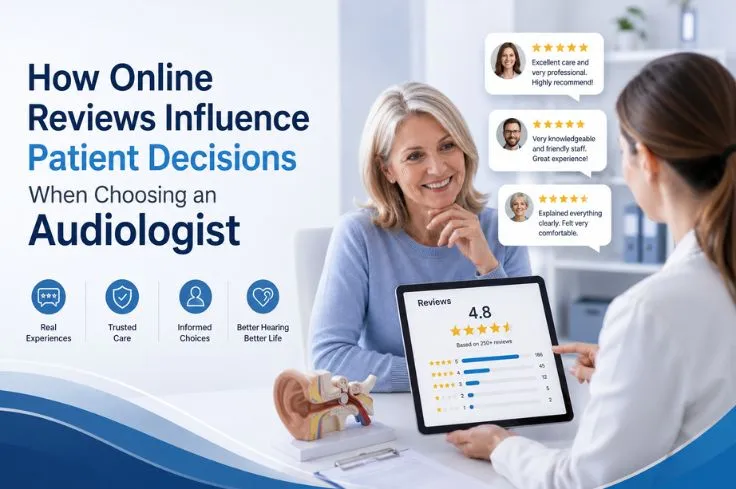
Online reviews play an important role in how patients choose an audiologist. Positive reviews build trust, showcase patient experiences, and help your practice stand out when people search for hearing care online.
Choosing an audiologist is a personal decision. Patients may be dealing with hearing changes, tinnitus, communication difficulties, or concerns about a family member. Before scheduling an appointment, many want to feel confident that they are choosing a practice where they will be heard, respected, and properly cared for.
That is why online reviews have become an important part of the patient decision process.
A prospective patient may find an audiology practice through Google, a referral, an advertisement, or a local search. Even when someone receives a recommendation from a physician, friend, or family member, they may still look up the practice and read patient reviews before making an appointment.
For audiology practices, understanding how reviews influence these decisions can help you create a better experience from the first online search to the first appointment.
Why Online Reviews Matter in Audiology
Hearing care is different from many everyday purchases. Patients are not simply comparing products or prices. They are choosing a healthcare professional they may rely on for testing, hearing technology, counseling, follow-up care, and ongoing support.
That makes trust especially important.
A website can explain your services, introduce your audiologists, and describe your approach to hearing care through a strong audiology SEO strategy. Reviews add another layer by showing what previous patients say about their experience.
Before contacting an audiologist, prospective patients may want to know:
- Was the staff friendly and helpful?
- Did the audiologist take time to listen?
- Where hearing test results explained clearly?
- Did the patient feel pressured when discussing hearing aids?
- Was scheduling easy?
- Did the practice provide helpful follow-up care?
- Did patients feel comfortable asking questions?
Reviews can provide real-world context that a service page alone cannot always communicate.
Reviews Can Shape the First Impression of Your Practice
For many patients, their first impression of an audiology practice happens before they visit the website.
Imagine someone searches Google for an “audiologist near me.” Several local practices appear.
One practice has a strong rating, a steady collection of recent reviews, and detailed comments about the patient experience. Another has very few reviews, with the most recent one posted two years ago.
Even if both practices provide excellent hearing care, they may create very different first impressions online.
Patients do not always analyze every detail. They may quickly notice the overall rating, number of reviews, how recent the reviews are, and what people are saying. This can determine which practice they research further.
Patients Look Beyond the Star Rating
A high average rating can help attract attention, but the number of stars is only one part of the story.
Many patients read the actual comments.
A five-star rating tells someone that a patient had a positive experience. A detailed review can explain why. For example, comments about an audiologist being patient, answering questions clearly, or helping someone feel comfortable during a hearing evaluation provide more useful context than the rating alone.
Patients may also look for reviews from people whose situation sounds similar to their own.
Someone considering hearing aids might pay more attention to comments about hearing aid selection and follow-up support. A patient scheduling their first hearing test might notice reviews describing how comfortable and straightforward the evaluation was.
This makes the substance of reviews important, not just the score attached to them.
Recent Reviews Can Give Patients More Confidence
Patients may also consider when reviews were written. A practice could have hundreds of positive reviews, but if very few were posted recently, a prospective patient may wonder whether those experiences still represent the practice today.
Recent reviews can provide a more current picture.
They may reflect today’s staff, appointment process, office environment, technology, and patient experience. This does not mean an audiology practice needs new reviews every day. The important point is consistency.
A natural flow of reviews over time can show prospective patients that people are continuing to visit the practice and share their experiences.
Reviews Help Patients Understand What the Experience May Be Like
Uncertainty can make it harder for someone to schedule healthcare.
A first-time audiology patient may not know what happens during a hearing evaluation. Someone considering hearing aids may be concerned about cost, technology, comfort, or whether they will receive ongoing support.
Reviews can reduce some of that uncertainty.
Patients often describe details such as:
- How they were welcomed by the front desk
- Whether appointments started on time
- How clearly the audiologist explained test results
- Whether questions were answered
- How hearing aid options were discussed
- What follow-up appointments were like
- How staff handled a concern or problem
These details can help prospective patients picture themselves visiting the practice.
When the experiences described in reviews match what a patient is looking for, scheduling an appointment can feel like an easier decision.
Reviews Can Reinforce a Physician or Family Referral
Referrals remain valuable in hearing healthcare.
A primary care physician may recommend an audiologist. An ENT may refer a patient for hearing testing. A family member may suggest the clinic where they received hearing aids. However, a referral does not always mean a patient will immediately schedule.
Many people still research the recommended practice online. They may visit the website, look at the location, read about the providers, and check reviews. Positive patient experiences can reinforce the original recommendation.
In this situation, online reputation does not replace referrals. It supports them.
When the information patients find online aligns with what they were told by someone they trust, they may feel more comfortable taking the next step.
Negative Reviews Can Affect Patient Decisions Too
No practice can completely control what patients say online. Even practices that provide excellent care may occasionally receive a negative review.
Prospective patients understand this. In some cases, seeing a small number of critical reviews among many positive ones can appear more natural than seeing nothing but perfect feedback.
What often matters are the context.
A potential patient may look at what the complaint was about, whether similar complaints appear repeatedly, and whether the practice responded appropriately. One complaint about a scheduling issue may not discourage someone. Multiple recent reviews describing the same problem may have a much greater impact.
Patterns matter. Practices should therefore pay attention not only to their average rating but also to recurring themes within patient feedback.
How a Practice Responds to Reviews Can Build Trust
Patients are not the only people reading review responses. Prospective patients may read them too.
A professional response to a positive review can show appreciation. A thoughtful response to a critical review can demonstrate that the practice takes patient feedback seriously.
For healthcare practices, responses also need to be handled carefully because patient privacy matters.
A public response should not confirm private health information or discuss the details of someone’s care. Instead, practices can keep responses professional, respectful, and focused on taking the conversation offline when appropriate.
The goal should not be to win an argument. The goal is to show anyone reading the exchange that the practice communicates professionally and cares about the patient experience.
Reviews Can Help Patients Compare Audiologists
Patients often have several choices, particularly in larger communities. They may compare practices based on location, insurance information, available services, provider experience, appointment availability, and online reputation.
Reviews can become a deciding factor when other details are similar. Consider two audiology clinics offering similar services within the same area. Both have professional websites and experienced providers.
If one has recent reviews consistently mentioning clear communication, compassionate care, and helpful follow-up, those comments may give the patient additional confidence.
In other words, reviews can help make qualities that are difficult to communicate through marketing more visible.
Specific Feedback Can Be More Valuable Than Generic Praise
Not all positive reviews provide the same amount of information.
A comment such as “Great place” is positive, but it tells a prospective patient very little.
A review describing how an audiologist listened carefully, explained the hearing test, answered questions, and helped the patient understand their options provides much more context.
Specific reviews can reveal qualities patients care about when choosing a provider.
Common themes may include:
- Communication: Did the audiologist explain information in a way the patient could understand?
- Comfort: Did the patient feel relaxed and respected?
- Personal attention: Did the provider listen to the patient’s concerns?
- Professionalism: Was the team organized, knowledgeable, and courteous?
- Follow-up support: Did the practice continue helping after the initial appointment?
These details can make reviews more meaningful during the decision process.
Online Reviews Are One Part of the Overall Patient Journey
Reviews are important, but they do not work in isolation.
A prospective patient might first discover an audiology clinic through a local Google search. They may then check reviews, visit the practice website, read about hearing services, learn about the audiologists, and finally look for a way to schedule. This is where a smooth lead conversion process can help turn online interest into an appointment.
Every step contributes to the final decision. This is why audiology practices should think about reputation as part of the broader patient journey.
If reviews create a positive impression but the website is difficult to use, the patient may leave. If the website looks professional but online feedback raises concerns, the patient may continue searching.
Consistency across these touchpoints helps build confidence.
What Can Audiology Practices Learn from Their Reviews?
Patient reviews are not only useful for prospective patients. They can also provide valuable feedback for the practice itself.
Look for recurring themes.
Are patients frequently praising a particular audiologist for explaining hearing test results clearly? Do several people mention friendly front desk staff? Are there repeated complaints about phone calls, scheduling, parking, or wait times?
These patterns can highlight both strengths and opportunities for improvement. Positive themes can help you understand what patients value most about your practice. Critical feedback can identify parts of the experience that may need attention.
Listening to patient feedback can therefore support both reputation and the overall quality of the patient experience.
Building Trust Before the First Appointment
Patients often begin forming an opinion about an audiology practice long before they walk through the door.
Online reviews can influence whether they trust the practice, whether they continue researching it, and whether they ultimately decide to schedule an appointment.
For audiologists and hearing clinics, the goal should not simply be to collect as many five-star ratings as possible. A stronger approach is to create consistently positive patient experiences, make it easy for patients to share genuine feedback, pay attention to what they are saying, and communicate professionally when responding.
Over time, those experiences can create an online reputation that reflects the quality of care your practice works to provide.
Strengthen Your Audiology Practice's Online Reputation
Patients often begin forming an opinion about an audiology practice long before they walk through the door.
Online reviews can influence whether they trust the practice, whether they continue researching it, and whether they ultimately decide to schedule an appointment.
For audiologists and hearing clinics, the goal should not simply be to collect as many five-star ratings as possible. A stronger approach is to create consistently positive patient experiences, make it easy for patients to share genuine feedback, pay attention to what they are saying, and communicate professionally when responding.
Over time, those experiences can create an online reputation that reflects the quality of care your practice works to provide.
Get in Touch
Want to attract more patients and build a stronger online presence? Get in touch with Audiology Plus today and discover how we can help your audiology practice grow.
Get Started with a
Free Consultation
Unlock the full potential of your marketing efforts.
