
AEO and GEO for Audiologists and ENT Practices
ChatGPT | Google Al Overviews | Voice Search | other Al-powered Search ExperiencesThe way patients search for hearing and ENT care is changing. Google is still important, but patients can now ask questions through Google AI Overviews, ChatGPT, Perplexity, Microsoft Copilot, voice assistants, and other AI-powered search experiences.
Audiology Plus provides AEO and GEO for audiologists and ENT practices to help make your website, services, expertise, and practice information easier for AI-powered search systems to find, understand, and reference.
Our approach combines Answer Engine Optimization, Generative Engine Optimization, structured content, entity optimization, authority building, and ongoing AI visibility monitoring.
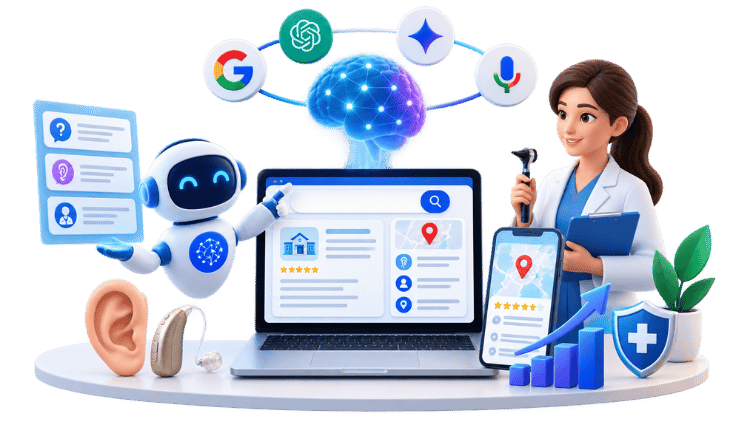
Understanding AEO and GEO in AI-Powered Search
Answer Engine Optimization (AEO)
Answer Engine Optimization (AEO) helps search and answer engines understand your website content and use it when responding to patient questions. AEO for audiologists and ENT practices focuses on providing clear, useful answers based on how patients naturally search.
- Answers common patient questions clearly
- Uses question-based and conversational content
- Organizes service information for easier understanding
- Creates clear, structured page layouts
- Uses relevant schema markup
- Helps answer engines identify useful information about your services
Example patient searches:
“When should I see an audiologist for hearing loss?”
“When should I see an ENT for tinnitus?”
Generative Engine Optimization (GEO)
Generative Engine Optimization (GEO) helps generative AI systems better understand your practice, providers, services, expertise, and overall digital presence. GEO for audiologists and ENT practices focuses on building clear and consistent signals across trusted online sources.
- Clarifies who your practice is
- Establishes your practice location
- Defines the services you provide
- Connects providers with your practice and services
- Highlights provider experience and credentials
- Builds consistency across websites, directories, reviews, and other sources
Example patient searches:
“Which audiologists near me specialize in tinnitus?”
“Recommend an audiologist near me.”
Why AEO and GEO Matter for Audiology and ENT Practices
Patients often have questions before they know which provider or service they need.
Someone experiencing ringing in the ears may search for tinnitus treatment, ask whether they should see an audiologist or ENT, or ask an AI assistant what could be causing the problem.
Another patient may ask where to get a hearing test, how hearing aids work, or which type of specialist treats balance problems.
AI-powered search can become part of this research process.
That means your practice needs to be understandable not only to traditional search engines, but also to systems that organize information into direct answers and conversational responses.
A strong AEO and GEO strategy can help your practice:
- Improve visibility across emerging AI search experiences
- Make important service information easier for answer engines to understand
- Build clearer connections between your practice, providers, services, and locations
- Address the questions prospective patients ask during their search
- Strengthen your practice's online authority and credibility
- Improve consistency across your website and external profiles
- Prepare your digital presence for changing patient search behavior

How Patients Are Finding Hearing and ENT Practices Today
Google Search
Patients search for symptoms, treatments, and local providers
Al Overviews
Create Al Overviews deliver direct anowers at the top.
ChatGPT & AI Assistants
Patients ask AI tools for recommendations and advice.
Voice Search
Voice assistants provide quick answers and local options.
Our AEO & GEO Services for Audiologists and ENT Practices
Al Visibility Audit
See hour your practice appears across relevant Al search experiences.
Structured Data & Entity Optimization
Help machines understand your providers, services, and location
Authority & Citation Building
Strengthen the trusted signala surrounding your practice.
Answer-Ready Content
Build clear answers around real patient questions.
Voice Search Optimization
Prepare content for conversational searches and voice assistants.
Al Vialbility Tracking
Track mentions, sources, competitors, and visibility trends.
Build a Stronger Presence in AI Search
AEO and GEO Process for Stronger AI Search Visibility
Audit & Understand
We review your services, providers, locations, website, current search strategy, and visibility across AI-powered search experiences.
Research & Optimize
We identify important patient questions and conversational searches, then optimize your content, service information, entity signals, and structured data.
Build Content & Authority
We create AI-focused content and strengthen the profiles, citations, reviews, mentions, and other signals that support your practice's online authority.
Track & Improve
We monitor priority queries and AI visibility trends, then use ongoing insights to improve your content, authority, and optimization strategy over time.
AEO and GEO vs. Traditional SEO
Traditional SEO, AEO, and GEO work together to strengthen your practice’s visibility across different search experiences. SEO builds the search foundation, while AEO and GEO expand your reach across answer engines and AI-powered search.
AEO and GEO
AEO and GEO help your practice become easier for AI-powered search platforms and answer engines to understand. The focus is on creating clear answers, strengthening your practice information, and building authority signals that can support visibility when patients use AI tools to research hearing and ENT care.
- Optimizes content for AI-powered and conversational searches
- Creates clear, answer-ready content around patient questions
- Builds authority through credible mentions, citations, and consistent information
- Supports visibility across AI search and answer experiences
Traditional SEO
Traditional SEO helps your practice become more visible when patients use search engines to find services, providers, and healthcare information. It focuses on improving your website’s content, technical structure, relevance, and authority to support stronger organic search performance.
- Targets relevant keywords based on patient search intent
- Optimizes service pages and website content
- Improves technical structure and search engine accessibility
- Strengthens internal linking and website authority
- Supports higher organic visibility, qualified traffic, and patient discovery
- Builds consistency across websites, directories, reviews, and other sources
Why Choose Audiology Plus for AEO and GEO?
AI search optimization is not simply a technical marketing exercise. For hearing and ENT practices, it requires an understanding of patient search behavior, healthcare content, local visibility, reputation, provider authority, and digital marketing.
Audiology Plus focuses specifically on marketing for audiology and ENT practices. That industry focus allows us to build AEO and GEO strategies around the questions your patients ask and the services your practice actually provides.
- Audiology and ENT Marketing Experience: Industry-focused marketing knowledge built around the needs of hearing and ENT practices.
- Answer Engine Optimization: Content structured to answer patient questions clearly across AI and answer-driven search.
- Generative Engine Optimization: Strategies designed to strengthen how AI platforms understand and reference your practice.
- Healthcare Content Strategy: Patient-focused content planned around services, search behavior, and healthcare decision-making.
- Entity Optimization: Clear connections between your practice, providers, services, locations, and areas of expertise.
- Structured Data: Relevant schema markup that helps search engines better understand your website information.
- Reputation Signals: Reviews, ratings, and trust signals that support credibility across search and AI platforms.
- Local Visibility: Stronger practice information and local signals to support discovery in nearby patient searches.
- Authority Building: Credible content, mentions, and expertise signals that strengthen your practice’s online presence.
- AI Visibility Monitoring: Ongoing tracking of practice mentions, competitor visibility, and changes across AI search experiences.
Frequently Asked Questions
Audiology practices can appear in AI-powered search experiences when platforms have enough relevant and trustworthy information to understand the practice and its services. Visibility can vary based on the question, platform, location, available sources, and other factors, so no agency can guarantee inclusion in a particular AI-generated answer.
No. AEO and GEO complement traditional SEO. Search engines and AI systems still need accessible, useful, and credible web content. A strong SEO foundation can therefore support your broader AI search strategy.
Schema can help machines understand information about a webpage and the entities it describes, but schema alone does not guarantee AI visibility. It works best alongside high-quality content, clear entity information, strong authority signals, and a technically accessible website.
Measurement may include monitoring tracked AI prompts, practice mentions, competitor visibility, cited sources, AI referral traffic, organic search performance, and changes in visibility across priority topics. Because AI responses can change, performance should be evaluated over time rather than based on one response.
There is no fixed timeline for appearing in AI-generated results. Changes to website content and technical signals may be discovered relatively quickly, while building stronger authority, citations, reputation, and entity recognition can take longer. Results also depend on your market, competition, existing online presence, and the AI platform being evaluated.
Yes. In many cases, AEO and GEO can be incorporated into an existing website. We can review your current content, provider pages, service pages, technical structure, schema, authority signals, and online presence to identify opportunities without rebuilding the entire website.
Get Started with a
Free Consultation
Unlock the full potential of your marketing efforts.
