
Tele-Audiology Marketing: A Playbook for Remote Hearing Care
Introduction
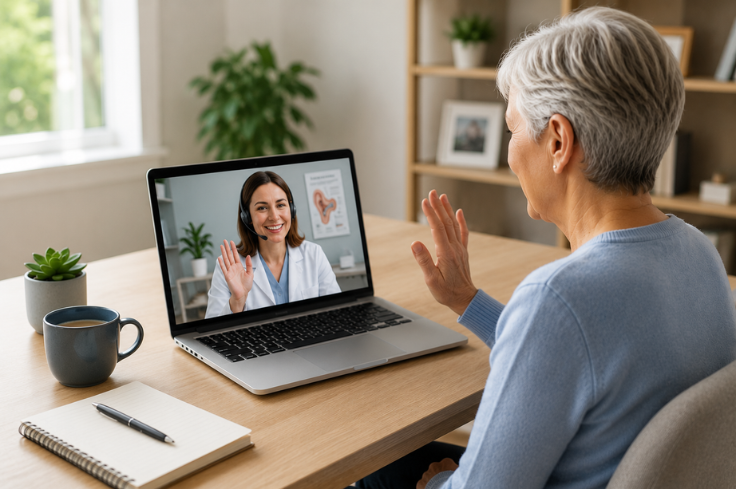
Tele-audiology is transforming the way hearing care providers deliver services by making consultations, follow-up appointments, and hearing support more accessible and convenient. As demand for remote healthcare continues to grow, having the right marketing strategy is essential for attracting new patients, building trust, and expanding your practice. This playbook explores practical tele-audiology marketing strategies to help your clinic increase visibility, improve patient engagement, and achieve sustainable growth.
Here is a number that should stop every clinic owner mid-scroll: roughly three out of four counties in the United States do not have enough hearing care providers. Now pair that with a second number. The share of audiologists offering tele-audiology services jumped from 43 percent in 2018 to 86 percent by 2021, and it has stayed a core part of hearing care ever since.
So the capability is there. The need is there. What is missing? Patients who actually know your clinic offers it.
That is the strange position tele-audiology finds itself in right now. Research shows that while more than half of patients have heard of tele-audiology, only a tiny fraction have ever used it. The gap between “I’ve heard of that” and “I booked a remote appointment” is not a technology problem. It is a marketing problem. And for the clinics that solve it first, it is also a growth engine.
This post walks you through a practical marketing playbook for promoting remote hearing care: how to position it, which patients to target, what to say on your website, and how to turn tele-audiology from a quiet service line into a steady source of new appointments.
Why Tele-Audiology Deserves Its Own Marketing Plan
Most clinics treat remote care as a footnote. It sits in a dropdown menu, maybe gets one line on the services page, and never appears in an ad. That made sense in 2020, when tele-audiology was an emergency workaround. It makes no sense in 2026.
Consider what remote hearing care can actually cover today: hearing screenings, follow-up consultations, hearing aid programming and fine-tuning, counseling, and troubleshooting. Studies comparing remote hearing aid follow-ups with in-person visits have found the outcomes and satisfaction levels to be comparable. This is not a lesser version of your service. It is your service, delivered without the drive.
Now think about who benefits most:
- Rural patients who live an hour or more from the nearest audiologist
- Older adults with mobility challenges for whom every clinic visit requires a family member, a ride, and half a day
- Busy working adults who keep postponing that hearing test because they cannot fit it between meetings
- Existing hearing aid wearers who need a quick adjustment, not a waiting room
Each of these groups represents patients your competitors are not reaching either. The World Health Organization estimates that the vast majority of people who could benefit from hearing aids never get them. Distance, inconvenience, and friction are big reasons why. Tele-audiology removes all three, but only if people know it exists at your clinic.
Positioning: Sell the Outcome, Not the Technology
The fastest way to kill interest in tele-audiology is to market it as technology. “We offer synchronous remote audiometric services via secure video platform” means nothing to a 68-year-old in a farming town who just wants to hear his grandkids again.
Here is the reframe. You are not selling video calls. You are selling:
- No more long drives. “Get your hearing aids adjusted from your living room.”
- Faster help. “Most remote appointments available within 48 hours.”
- Family involvement. “Your daughter in another state can join the appointment too.”
- Comfort and dignity. “Skip the waiting room. Keep your routine.”
Notice that every one of these speaks to a feeling, not a feature. Your website copy, your Google Business Profile posts, your ads, and your front desk scripts should all follow the same rule: lead with the life benefit, mention the technology second, and reassure on quality third.
That third part matters more than most clinics realize. The biggest hesitation patients report about remote care is a quiet worry that it will not be “as good” as coming in. Answer that head-on. A single line like “Remote follow-ups have been shown in clinical research to deliver results comparable to in-person visits” does a lot of trust-building work. So does a short FAQ on your tele-audiology page that answers questions like “Will my audiologist be able to really test my hearing?” and “What if something needs hands-on care?” Honesty about the limits, such as ear wax removal or certain diagnostics still requiring an office visit, actually increases credibility rather than reducing it.
Build a Dedicated Tele-Audiology Landing Page
If remote care lives only as a paragraph on your general services page, search engines cannot rank it and patients cannot find it. Give it a page of its own, and build that page to convert.
Here is what a high-performing tele-audiology page includes:
- A clear headline with location intent. Something like “Remote Hearing Care for Patients Across [State]” tells both Google and the visitor exactly what this is and who it serves. Remember, your service area for remote care is far larger than your physical draw radius. Your page should claim that territory.
- A simple three-step “how it works” section. Book online, connect from your phone or computer, get expert care. Use plain language and, ideally, photos of your actual audiologists rather than stock imagery.
- Eligibility guidance. A short checklist of what can be handled remotely versus what needs an office visit. This filters inquiries and sets expectations.
- Proof. A testimonial from a real remote patient is gold. If you do not have one yet, ask after your next few successful remote appointments. A quote from a rural patient about avoiding a two-hour round trip will do more persuading than any paragraph you write.
- One obvious action. A booking button or phone number, repeated at least twice on the page. Not five options. One.
From an SEO standpoint, this page also lets you target searches your competitors ignore: phrases like “remote hearing test,” “online audiologist appointment,” “hearing aid adjustment from home,” and “tele-audiology near me.” Search volumes on these terms are still modest, which is exactly the point. Low competition today means an easier path to the top result, and these queries are growing as remote care normalizes across healthcare.
Make Remote Care Visible Where Patients Actually Look
A landing page is the foundation, but discovery happens in more places than your website. Three channels deserve special attention.
Your Google Business Profile. Add tele-audiology as a service, mention it in your business description, and post about it monthly. When patients read your reviews and see mentions of convenient remote appointments, that social proof compounds. It is also worth remembering that patients increasingly ask AI assistants and search chatbots to find providers for them, and those tools pull heavily from consistent, structured business information. A clinic whose profile clearly states “offers remote hearing care” is a clinic that gets recommended for it.
Email to your existing patient base. Your fastest tele-audiology wins are not new patients. They are current hearing aid wearers who do not know they can get adjustments without driving in. A single email with the subject line “Your next adjustment, without the trip” can fill remote slots within days. Segment for patients who live farthest from your office and those overdue for follow-ups.
Targeted paid campaigns. Remote care changes the math on your ad geography. Traditionally, a hearing clinic advertises within a 15 to 25 mile radius because nobody drives further. With tele-audiology, you can run search ads across your entire state for follow-up and consultation services. Underserved rural zip codes with no local audiologist are especially efficient targets: high need, low competition, low cost per click. Pair the ads with your dedicated landing page, never your homepage.
Train Your Front Desk to Offer It
This is the step nearly everyone skips, and it quietly determines whether the whole strategy works. Your front desk is your highest-converting marketing channel, and most schedulers default to booking in-person visits because that is the habit.
Give them one simple script change. When a patient calls about a follow-up, adjustment, or consultation, the scheduler asks: “Would you prefer to come into the office, or would a video appointment from home work better for you?” That one question, asked consistently, does three things. It normalizes remote care, it surfaces demand you did not know existed, and it frees up in-office slots for the appointments that truly need them, like fittings and diagnostics.
Track it, too. Add a field in your scheduling system for appointment type and review the remote share monthly. If it is not growing, the marketing is not the problem. The offer is not being made.
Practical Tips You Can Apply This Week
You do not need a six-month project plan to start. Here is a short list you can act on immediately:
- Audit your website today. Search your own site for any mention of remote or tele-audiology services. If a new visitor cannot find it in ten seconds, neither can Google.
- Draft the landing page first. Everything else, from ads to emails, points to it. Get this one asset right before spending a dollar on promotion.
- Send one email this month to existing patients announcing remote follow-ups. Keep it under 150 words with a single booking link.
- Update your Google Business Profile with tele-audiology listed as a service and one post announcing it.
- Add the front desk question to your scheduling scripts and brief the team in your next huddle.
- Collect one remote-care testimonial in the next 30 days and feature it prominently.
- Set a 90-day goal. For example: 10 percent of eligible follow-up appointments conducted remotely. What gets measured gets marketed.
None of this requires new equipment or new staff. Most clinics already have the clinical capability. The playbook simply makes that capability visible, credible, and easy to say yes to.
The Clinics That Move First Will Own This
Tele-audiology sits in a rare window right now. Patient demand for convenient care keeps rising, the clinical evidence supports remote delivery, provider shortages leave entire regions underserved, and yet very few hearing clinics market remote services with any real intention. That combination will not last. As remote care becomes standard across healthcare, the clinics that built their tele-audiology presence early will hold the search rankings, the reviews, and the reputation that latecomers have to fight for.
Start with the landing page. Add the front desk question. Send the email. Small moves, made now, compound into a patient pipeline your competitors cannot easily copy.
And if you would rather have specialists handle the strategy, the SEO, and the campaigns while you focus on patient care, that is exactly what we do. Talk to the Audiology Plus team about building a marketing plan that puts your clinic in front of the patients searching for care, wherever they live.
Get in Touch
Ready to grow your audiology practice with smarter digital marketing and remote hearing care strategies? Our team helps hearing healthcare providers build stronger patient connections, improve online visibility, and create marketing systems that drive measurable growth, so whether you want to explore tele-audiology opportunities, improve patient engagement, or develop a customized marketing plan for your clinic, we’re here to help.
Get Started with a
Free Consultation
Unlock the full potential of your marketing efforts.
